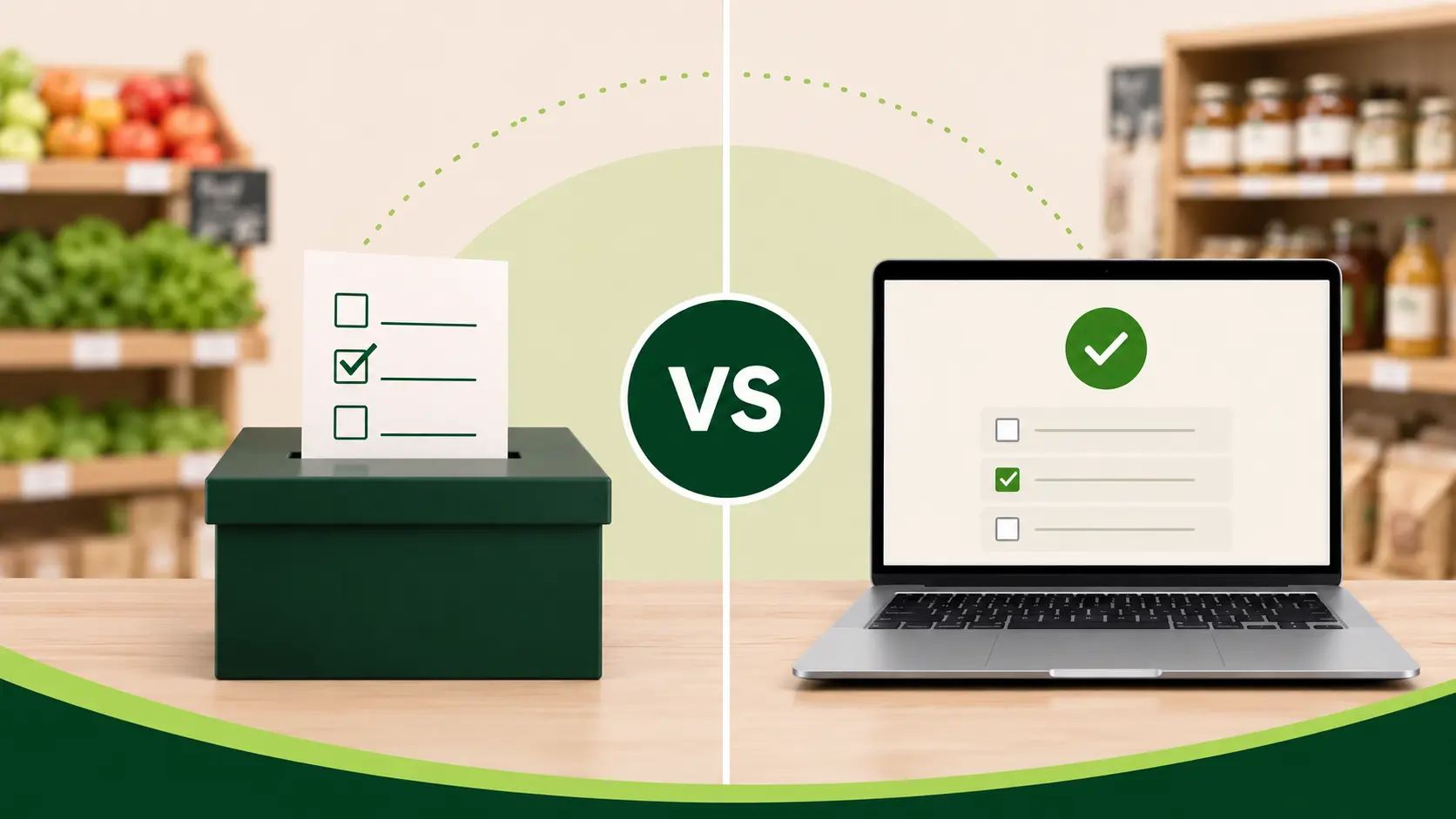
Not sure whether your co-op should use paper or digital ballots?
| Paper ballots are best for: | Digital ballots are best for: |
|---|---|
| Areas with limited internet access | Members with busy schedules |
| Co-ops with restrictive state laws or bylaws | Co-ops that are struggling with turnout |
| Co-ops with a limited ability to roll out new technology | Complex elections |
Member participation is the bedrock of any healthy food co-op. But voting methods can make a big difference in participation rates, not to mention the effort required to put on a compliant vote.
For many co-ops, paper ballots feel familiar and are part of the community experience. Even so, online voting is a practical option for organizations that want to increase turnout and reduce staff workload.
So, what’s the right option for your co-op? Learn how paper and digital food co-op elections compare and where each approach works best.
How Co-op Elections Usually Work
Annual meetings are important, but they’re mandatory for traditional in-person voting. Members gather in person, hear updates, and cast their votes on paper ballots. In some cases, co-ops also send mail-in ballots for members who can’t attend, which helps widen access a bit but still adds another layer of coordination for staff.
There’s a lot to like about this traditional setup. In-person voting can reinforce the sense of community that makes food co-ops special in the first place. Members get to participate together and see the democratic process unfold in real time – all while chatting with their friends. Paper ballots are also tangible, which can feel more trustworthy to members.
Still, paper-based elections are far from perfect. They can be slow and labor-intensive, making it a real chore for staff to manage. Ballots have to be printed, distributed, collected, secured, and counted by hand, when managed by the co-op.
Participation is also a big concern. If you offer only paper voting at the annual meeting, turnout will be limited to those who can attend. Even if you offer mail-in ballots, not everyone will fill them out, and your staff will still have to process them manually.
In-person, paper-based voting has some upsides, but today, many co-ops are looking for something that’s more convenient and easier to manage.
What Online Voting Looks Like for Food Co-ops
With online voting, you can run an election without requiring members to attend a single meeting. Instead of showing up in person to fill out a paper ballot, platforms like SnapBallot™ send verified members a unique access link to cast their vote online.
There’s a lot to love about electronic voting, including pros like:
It works across devices, so members can vote via their phones, tablets, or desktop computers.
You can lengthen the election window beyond the annual meeting (bylaws permitting), giving members more time to make their selections.
Include candidate bios, statements, and other helpful information within the ballot so members can make informed decisions, faster.
It ensures ballot privacy. Not even platform administrators can see how people voted.
For busy members, parents, shift workers, or anyone who can’t attend an in-person event, the flexibility of online voting removes barriers.
As much as we love online voting, the move to digital isn’t always frictionless. Some members might be really attached to the tradition of paper ballots. They need to trust the new process. That’s why the right platform matters. SnapBallot helps food co-ops embrace online voting with a secure, easy-to-manage platform without the complicated setup. It’s designed for regular people, so you don’t need to be a technology expert to build a ballot or cast a vote.
The Differences Between Paper vs Digital Food Co-op Elections
Sure, the obvious difference here is that one happens manually on paper, and the other happens online. But there are other differences between paper versus digital elections, and they can have a big impact on your co-op’s governance.
Trust and Security
Members can see and touch paper ballots, so they feel more secure and real. Since voting happens at the annual meeting, members can even see you collecting and securing the ballots.
Some members might trust paper ballots more, but they do have some security issues. There’s definitely a greater margin for human error, and occasionally misplaced or miscounted ballots when managed by hand.
Online voting is different, but that doesn’t mean it’s less secure than paper voting. Actually, it’s often more secure. For example, SnapBallot includes protections such as encrypted ballots, one-time access links, voter controls, and audit logs to secure your election.
Accessibility
Online voting can make participation easier for members who use screen readers, need larger text, or simply prefer to vote in a more comfortable setting. Members can adjust their browser settings, use their own device, and cast a ballot privately from home. That’s a big deal for members with disabilities.
From an accessibility standpoint, paper ballots can be harder to navigate. Members may need to attend a physical meeting, read standard print sizes, or spend time in a space that’s just not comfortable for their needs.
Online voting usually wins the accessibility race, but with one exception: internet access. If your food co-op is in a rural area with limited internet access, some members might feel uneasy about voting online. That’s why many co-ops take a hybrid approach, offering online voting as the default with a paper option for those interested.
Community-Building
Food co-ops aren’t just businesses. They’re a community, and annual meetings are also treated as both town halls and reunions. Members gather, share a meal, chat with candidates, and vote together. That experience matters, and for many co-ops, it makes governance meaningful.
Fortunately, online voting doesn’t have to replace community spirit. All it does is make voting easier. You can still hold your co-op’s annual meeting. When you handle voting online, the meeting can focus less on passing out ballots and more on actual member engagement. You can invite candidates to speak, answer member questions, and create space for discussion.
Effort and Cost
Paper-based voting comes with high printing costs, not to mention postage expenses for mail-in ballots. If your co-op doesn’t have an event space, you might even need to pay for a room rental. The less obvious costs also take the form of inefficiencies: your staff has to prepare lists, distribute ballots, and hand-count results. That’s a lot for a small team.
Online voting makes things much easier. For example, SnapBallot automates everything from verifying your voter list and distributing ballots to tracking real-time results. While online voting platforms come with software fees, the ROI is well worth it. In fact, SnapBallot is free for small co-ops with fewer than 15 members, and pricing scales based on your membership size, so you only pay for what you need.

Situations Where It’s Best To Use Paper Vs Online Ballots
Online voting is usually the easier option, but that doesn’t mean it’s the only choice for all food co-ops.
Paper ballots could make more sense if:
You have a very small, close-knit group that values in-person deliberation during voting.
Internet access is limited in your community.
Your co-op can’t roll out new technology right now.
Your bylaws or state laws require paper voting.
With that said, digital ballots are usually better if:
You have a larger co-op.
Your members are geographically distributed.
Members have varied schedules and don’t regularly attend annual meetings.
You want to improve turnout, especially with younger co-op members.
Your elections are complex and would benefit from automated reports and audit logs.
The good news is that you may not even need to choose between the two options. Survey & Ballot Systems, the experts behind SnapBallot, know that hybrid elections make it possible to give members the best of both paper and digital ballots, although they require careful oversight.
Build a Voting Process Members Actually Use
Paper ballots have a place in some food co-ops, especially if in-person voting is a big part of your culture. But for many, online voting is a simpler, more cost effective way to increase engagement rates and reduce staff burnout.
The goal here isn’t to replace community with technology, but to make voting so easy that more members will participate. With an easier voting process, your co-op will spend less time wrangling ballots and more time focusing on members.
That’s what SnapBallot does. Our user-friendly online voting platform helps food co-ops of all sizes run compliant elections more quickly.