Not sure how to personalize your HOA’s digital ballot? Follow these five tips to build ballots for diverse communities:
1. Enable digital voting
2. Design for accessibility and inclusivity
3. Offer weighted voting
4. Always test before launching
5. Use data and homeowner feedback to improve future elections
Every HOA wants high participation rates, but getting homeowners to vote isn’t always easy. To complicate matters, communities are more diverse today, and members all have different expectations and backgrounds. A generic ballot just won’t cut it in many cases.
The good news is that voting doesn’t have to feel complicated or disconnected from your community. The key to participation is customizing ballots to reflect your community and the homeowners you represent.
Learn why customized ballots are so important, what it means to personalize elections, and practical steps to design a custom voting experience with SnapBallot™.
What Does It Mean to Customize Ballots, and Why Does It Matter?
No two HOAs are exactly alike. Some are small, tight-knit communities where most neighbors know each other by name. Others are large, diverse associations with hundreds or thousands of households. Because of these differences, you can’t use a one-size-fits-all ballot and call it “good enough.”
So many factors affect how homeowners approach HOA voting, including:
Location
Communities with multilingual populations may need balloting materials available in multiple languages.
Age
Survey & Ballot Systems, the election experts behind SnapBallot, know that some associations have many older residents who prefer traditional, paper-based voting processes. Others skew younger and expect seamless digital experiences. Offering both online and traditional options can bridge generational gaps and reduce barriers to participation. Plus, many states require HOAs to offer both options anyway.
Background
Not all homeowners have the same level of education or familiarity with legal terms. That means you need to use plain language that prevents confusion. It’s also crucial to avoid phrases (such as “blacklisting” or “grandfathered in”) that, while they’re in common use, can alienate and offend diverse groups.
Customized ballots are the best way to honor your neighborhood’s quirks without forcing it into a generic template. It makes a real difference in several ways, helping you:
Build Trust: Trust is hard to earn and easy to lose. Creating member-focused ballots shows a level of care and respect for their needs that supports lasting trust.
Stay compliant: In some cases, customization is required by law. For example, you might need to choose a voting platform that’s compatible with screen readers.
Boost participation: More people vote when they can understand the ballot and believe that it reflects their interests.
Voting can feel deeply personal because it directly affects property values, neighborhood rules, and quality of life. Customized ballots acknowledge those differences rather than ignoring them.
5 Tips for Creating Effective Customized Ballots
Personalizing ballots doesn’t mean reinventing the election process. It means tailoring the details, so the experience aligns with your members’ needs. Follow these best practices to personalize ballots for your HOA.
1. Digitize the Ballot
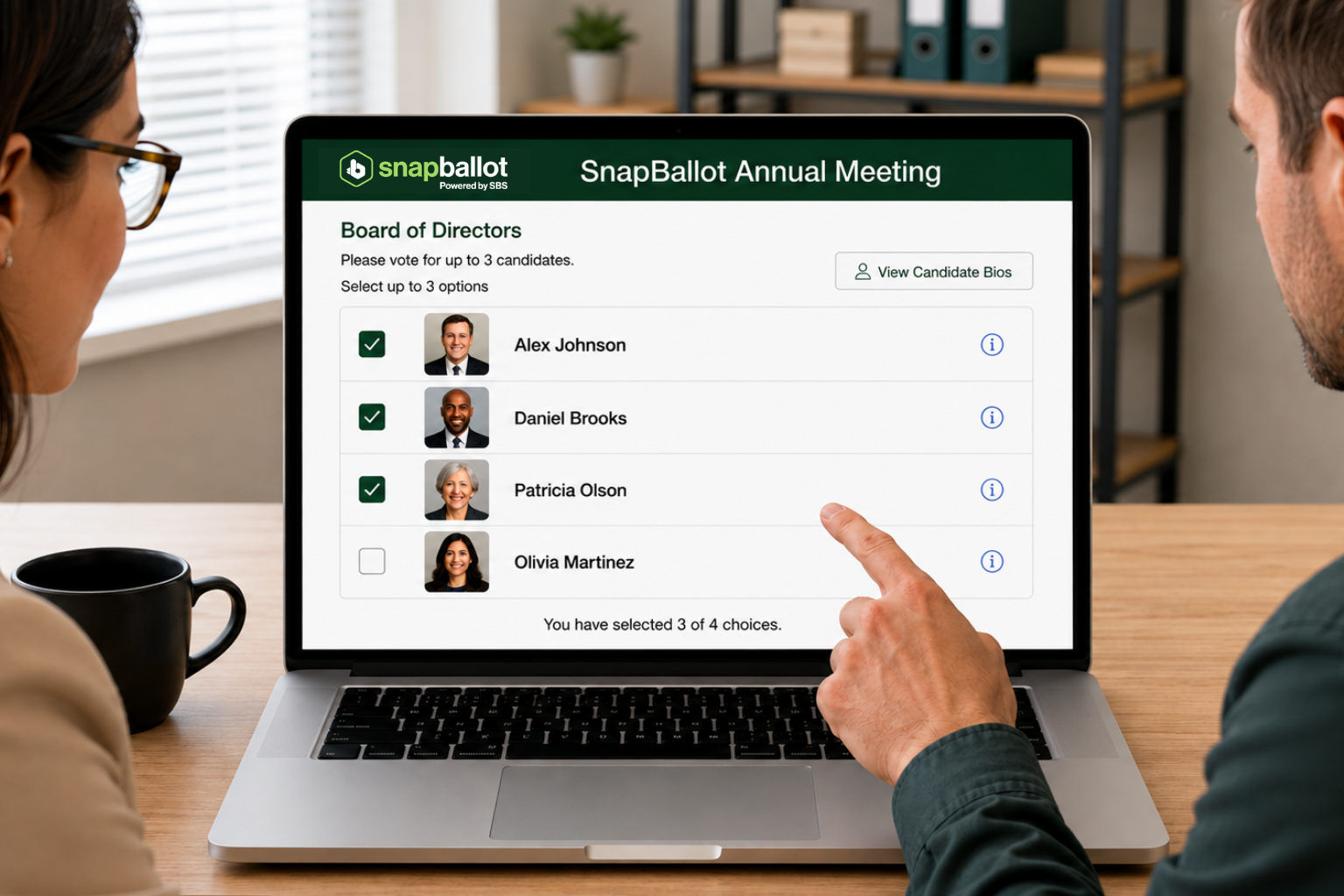
Digital ballots give HOAs a degree of flexibility that paper simply can’t match. With SnapBallot, you can create and manage elections in a DIY setup that keeps your team in control of the process. Instead of only offering paper ballots, you can build dynamic online ballots that include candidate bios, supporting information, and clear instructions all in one place.
Another major advantage is ballot flexibility. If a candidate withdraws or details change, you can update the ballot without pricey reprints or delays, as long as it’s before voting starts.
2. Be Accessible and Inclusive
The less accessible your voting process is, the less likely people are to participate.
Did you know that one in four Americans has a disability affecting their hearing, vision, mobility, and cognition? These differences show up in people’s voting patterns. In the 2022 national election, 15.8 million voters reported having a disability, and 15.3 million of these respondents didn’t vote.
Accessible design means creating ballots that work for all homeowners, including those with disabilities. This includes features like screen-reader compatibility, clean formatting, and mobile-friendly layouts so homeowners can vote from any device. It also means removing mandatory requirements for in-person voting, if you have those in place.
Language should also be simple and respectful. Avoid jargon or overly technical phrasing that could confuse voters. Aim for plain language that reads at roughly a sixth-grade level so everyone can clearly understand their options. Run all of your materials through a grade-level checker to ensure you’re speaking as clearly as possible.
3. Offer Weighted Voting
Does your HOA offer weighted voting? With this option, you upload your voter database and assign votes based on square footage or by the number of units someone owns. SnapBallot supports this type of weighted voting, helping HOAs gather input that better reflects the full range of homeowner perspectives, and how the organization is structured.
4. Test Before Launching
Even the most carefully designed ballot can have oversights. Before launching a customized ballot for the first time, conduct a few tests first. Early feedback can prevent problems that might otherwise discourage voters or create frustration on election day. A small pilot election or sample ballot review gives homeowners the chance to spot confusing language, unclear instructions, or technical hurdles before they affect real participation. SnapBallot offers a free pilot program for fewer than 15 voters, which can be a great way to test your setup before election day.
5. Improve for Next Time
SnapBallot provides real-time election data and post-election reporting, helping you understand participation rates, voting patterns, and where engagement may drop off. That data gives you a clear starting point for improving the next election.
You can also follow up with participating homeowners through short surveys sent via email. Every SnapBallot election includes a complimentary satisfaction survey, where admins receive ratings and comments from voters, all within the platform.
Parse through this feedback to determine what worked, what didn’t, and what could be clearer next time. Feedback isn’t always easy to hear, especially when you worked hard on this election, but it’s one of the best ways to improve participation and build long-term trust. In many cases, homeowners offer thoughtful ideas that lead to meaningful improvements you might not have considered.

Customization Equals Trust and Turnout
Customized ballots are the new standard for digital HOA elections. They’re a practical way to boost participation, especially for diverse neighborhoods. Every HOA is different, which is why tailored voting experiences outperform one-size-fits-all setups every time.
You don’t need an IT team to design custom ballots or build accessible experiences. SnapBallot helps HOAs of all sizes design personalized ballots that are user-friendly – both for voters and admins.